
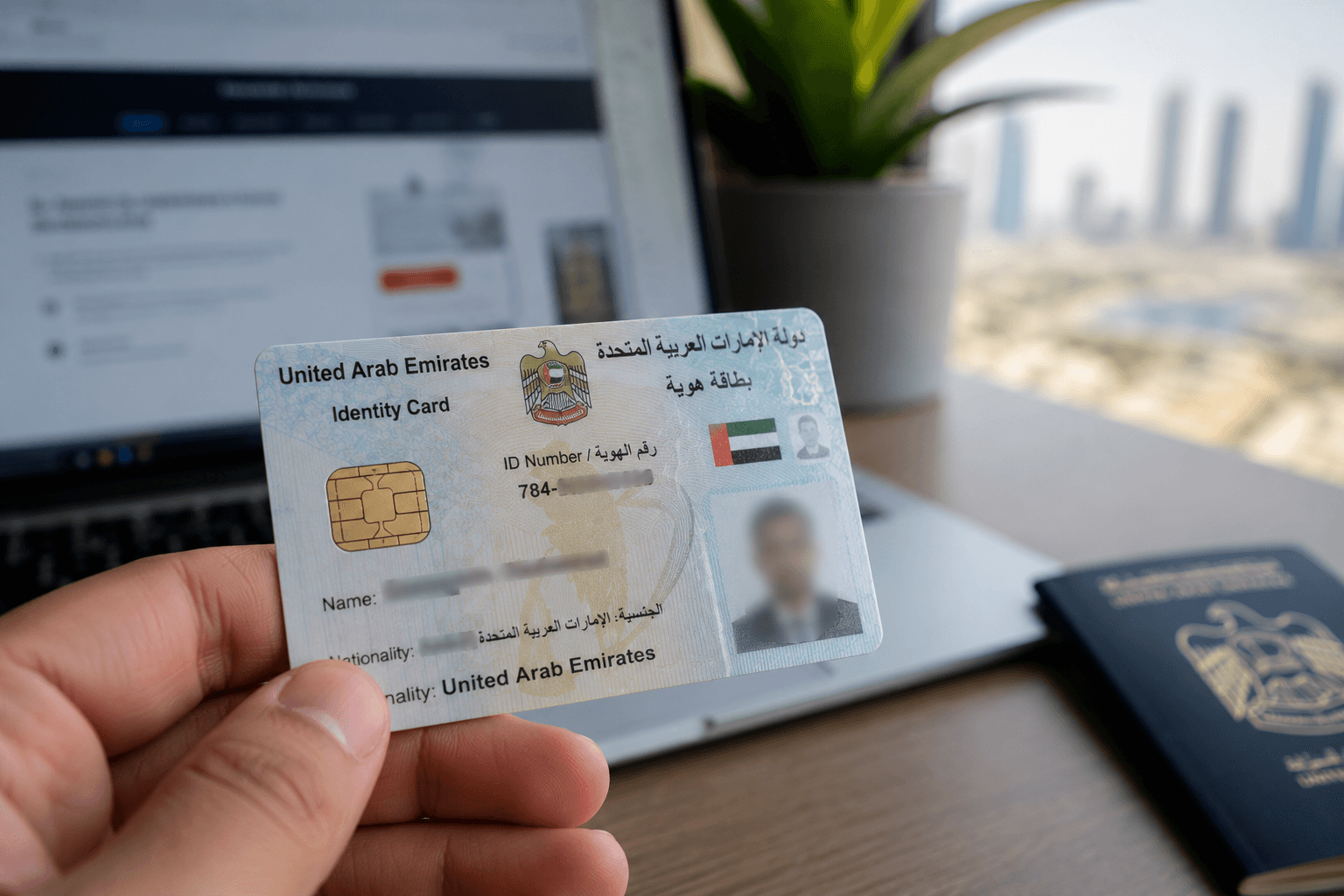

If you have ever applied for a visa in the UAE, renewed your Emirates ID, checked your residency status online, or even signed a tenancy contract - you have already used your UID number, even if you did not know it. It sits quietly in the background of almost every official process in the country, connecting your identity across every government system.
Most residents only go looking for it when something is not working - a status check returns no result, a government form asks for a number they cannot find, or a PRO tells them they need their "unified number" before they can proceed. This guide explains exactly what the UID number is, what its digits mean, how it differs from your Emirates ID number and file number, every place you can find it, and what to do in situations the official guides do not cover.
Key Takeaways
- A UID (Unified Number) is a 15-digit identifier issued by UAE immigration the moment a person's first visa is approved — it stays the same for life, even across different visa types or sponsors.
- The first 3 digits of a UID indicate the emirate that issued the first visa — for example, 201 means the visa was first issued in Dubai.
- UID, Emirates ID number, and File Number are three different identifiers: the UID is permanent, the Emirates ID number is tied to the physical card, and the File Number relates to the sponsor's immigration file.
- The fastest way to find a UID number is on the back of the Emirates ID card or on the visa page stamped inside the passport.
- If a person holds two UID numbers due to multiple past visa applications, they can be merged into one through GDRFA or ICP to avoid future visa-renewal conflicts.
- A UID number does not change when a passport is renewed — it remains linked to the individual, not the travel document.
What is a UID Number in UAE?
UID stands for Unified Identification Number. It is a permanent reference number assigned to every person who enters the UAE on a visa - residents, workers, investors, and tourists alike. The moment your visa is approved and processed by immigration, the system automatically generates a UID and attaches it to your file. You do not apply for it separately. It simply exists from the point your visa is live.
The number is issued by either the ICP (Federal Authority for Identity, Citizenship, Customs and Port Security) for visas issued in Abu Dhabi, Sharjah, and other federal emirates, or by GDRFA (General Directorate of Residency and Foreigners Affairs) for Dubai-issued visas. Regardless of which authority issues it, the number follows the same structure and serves the same purpose across all UAE government systems.
What makes the UID significant is its permanence. Your visa number changes every time you renew. Your passport number changes when you get a new passport. Your Emirates ID number changes when you replace the card. But your UID stays the same. It is the single thread that ties every document, every renewal, and every official record to one person across their entire history in the UAE.
What Do the Digits in Your UID Number Mean?
A UAE UID number is typically 15 digits long and is not a random sequence. Each section carries specific information about where and when your visa was issued.
The structure breaks down as follows: the first three digits represent the emirate code of the authority that issued your visa, the next four digits are the year your visa was issued, and the remaining seven to nine digits are your unique visa file number within that system.
So a UID that reads 201-2023-1234567 tells you the visa was issued in Dubai (201), in the year 2023, with file number 1234567.
| Emirate Code | Emirate | Issuing Authority |
|---|---|---|
| 101 | Abu Dhabi | ICP |
| 201 | Dubai | GDRFA Dubai |
| 301 | Sharjah | ICP |
| 401 | Ajman | ICP |
| 501 | Umm Al Quwain | ICP |
| 601 | Ras Al Khaimah | ICP |
| 701 | Fujairah | ICP |
This emirate code is also the reason why visa status checks sometimes fail. If your UID starts with 201, your file belongs to GDRFA Dubai - checking it on the ICP portal will return no result. Always match your search to the authority that issued your visa.
UID Number vs Emirates ID Number vs File Number
These three numbers cause more confusion than almost anything else in UAE immigration. They are related but they are not the same, and using the wrong one in the wrong place will either return no result or create errors in your file.
| UID Number | Emirates ID Number | File Number | |
|---|---|---|---|
| What it is | Unified Identification Number - your permanent immigration reference | The number printed on your Emirates ID card | Your immigration file reference at the issuing authority |
| Format | 15 digits (emirate code + year + visa number) | 15 digits starting with 784 | Varies by authority |
| Who gets it | Everyone with a UAE visa - residents and tourists | UAE residents only (not tourists) | Everyone with an immigration file |
| Does it change? | No - permanent for life | Changes if card is replaced or renewed after a name change | Can change if you switch sponsors or emirates |
| Used for | Visa status checks, ICP/GDRFA login, government services, tenancy, banking | Identity verification, banking, telecom, healthcare | Tracking a specific immigration application |
| Where to find it | Visa copy, Emirates ID (back), GDRFA/ICP portal | Front of Emirates ID card | Application receipt, visa sticker, sponsor records |
The simplest way to remember it: your Emirates ID number proves who you are. Your file number tracks a specific application. Your UID ties everything - every visa, every renewal, every document - to you as a single person across your entire time in the UAE.
Who Gets a UID Number in the UAE?
Any person who enters the UAE on a visa receives a UID. This includes residents on employment, investor, family, or student visas, visitors on short-term tourist or visit visas, GCC nationals who register their presence in the UAE, and long-term visa holders on Golden, Green, or Blue Visas.
UAE nationals do not have a UID in the same sense - their identity is managed through their Emirates ID and family book, which are linked to the national identity system rather than the immigration visa system.
For residents, the UID is permanent and does not change across visa renewals, employer changes, or even emirate transfers. For tourists and short-term visitors, the UID exists for the duration of their visa and is reactivated or linked if they return to the UAE on a new visa at a later date.
What is the UID Number Used For?
The UID appears across a wider range of situations than most residents expect. Here are the main ones.
Checking Visa and Residency Status Online
When you check your visa status on the ICP Smart Services portal or the GDRFA website, the UID is one of the primary reference numbers the system uses to locate your file. If you have renewed your passport and the new passport number is not yet updated in the system, your UID will still bring up the correct record.
Emirates ID Application and Renewal
When applying for an Emirates ID for the first time or renewing it, the system links your UID to your biometric data and card details. Without a valid UID attached to an approved visa, the Emirates ID application cannot proceed. This is why visa approval always comes before Emirates ID issuance.
Visa Renewal and Sponsorship Transfers
Every time you renew your residence visa - whether through the same employer, a new sponsor, or a self-sponsored category like the Green Visa - your UID is the reference that carries your history forward. It allows the system to verify your previous visa records, check for outstanding fines, and link the new visa to your existing identity file. For smooth visa renewals in Dubai, having your UID ready before you start any application saves time.
Business Setup and Trade License Applications
If you are setting up a company in the UAE as a resident investor or local sponsor, your UID is required when applying for a trade license. It links your personal identity to the business registration. For free zone and mainland business setup in Dubai, the trade license application, establishment card, and employee visa processes all reference the sponsor's UID.
Tenancy Contract Registration
In Dubai, all tenancy contracts must be registered through Ejari. When registering, both the tenant's and landlord's UID numbers are recorded. This creates a legal link between the person and the property that feeds into other government systems including utility connections, residency verification, and family sponsorship applications.
Driver's License
Opening a driving file with the Roads and Transport Authority (RTA) in Dubai, or its equivalent in other emirates, requires your UID. Your lessons, test results, and license history are tracked against this number. It also means if you switch driving schools or renew your license years later, the same file picks up where it left off.
Banking and Financial Services
Many UAE banks request your unified number as part of the account opening process or when updating your records. It is used to cross-reference your identity against government databases and verify your residency status.
Government Services and Applications
From health insurance registration to school enrolment, utility connections to court filings - almost every interaction with UAE government departments at both the federal and emirate level can require or reference your UID. It is the underlying identifier that allows different government systems to communicate about the same person.
How to Find Your UID Number in the UAE
There are several places to find your UID depending on what documents you have access to.
On Your Visa Copy
Your visa sticker or electronic visa copy (the PDF issued when your visa was approved) will show a field labelled Unified Number or UID No. It is usually located in the upper section of the document, near your file number and visa type. This is the most direct place to find it.
On the Back of Your Emirates ID
If you are a resident with a valid Emirates ID, your UID is printed on the back of the card, typically below the barcode. It is also embedded in the chip inside the card. Look for the label "Unified No." or a 15-digit number that starts with your emirate code.
Through the ICP Smart Services Portal
If your visa was issued outside Dubai, log in to the ICP portal at smartservices.icp.gov.ae using your UAE Pass or Emirates ID. Go to the file validity or residency services section and enter your passport number and nationality. Your UID will appear alongside your visa details.
Through the GDRFA Website (Dubai Visas)
For Dubai-issued visas, go to the GDRFA website and use the file validity inquiry service. Enter your passport number, date of birth, nationality, and gender. The system will display your file details including your unified number.
By Phone
You can call the GDRFA helpline at 800 5111 (toll-free within the UAE) or +971 4 313 9999 (from outside the UAE) and request your UID by providing your passport details. For ICP-issued visas, call the ICP customer service centre at 600 522 222, available 24 hours a day.
Through Your Employer or PRO
If your visa was processed by your employer or a PRO service provider, they will have your UID on file. Your HR department or company PRO can provide it instantly since it is part of your employee immigration record in their system.
How to Find Your UID If You Have Lost Your Visa Copy
This is a situation the official guides rarely address clearly. If you do not have your visa copy and your Emirates ID has expired or been lost, here is what you can do.
The fastest route is through your employer or sponsor - they hold your UID in their establishment file and can retrieve it without needing your physical documents. If you are self-sponsored or between jobs, go to the nearest Amer centre in Dubai or Tasheel centre in other emirates with your passport. The staff can look up your file using your passport number and date of birth and retrieve your UID on the spot. You can also call the GDRFA or ICP helpline with your passport number - they will ask a few verification questions and provide the number verbally.
What Happens to Your UID When You Renew Your Passport?
Your UID does not change when you renew your passport. The number is attached to your person, not to your passport. However, your new passport number needs to be updated in the immigration system so that future searches using your new passport number correctly link to your existing UID and residency file.
This update is normally handled as part of the visa renewal process. If you renew your passport mid-visa and do not immediately renew your visa, you or your PRO should update your passport details on the ICP or GDRFA portal. Failing to do this is one of the most common reasons status checks return "no record found" - the system is being searched with a new passport number that has not yet been linked to the existing UID.
For PRO services in Dubai that include passport update management and visa file maintenance, this is handled as a routine step rather than something you need to track yourself.
How to Merge Two UID Numbers in the UAE
It is possible to end up with two UID numbers - this typically happens when a person entered the UAE on a tourist visa that generated one UID, then received a residence visa that generated a second one, or when someone switched from one emirate's system to another at different points. Two UIDs for the same person can cause complications across government systems.
To merge them, you need to visit the GDRFA office in person (for Dubai) or the ICP service centre for other emirates. Bring your original passport, Emirates ID, copies of both visa documents that show the two different UIDs, and any other supporting identification. Submit a merging application form and the authority will consolidate both numbers into a single permanent UID. The process is not done online and requires the in-person visit, but it is straightforward once you have the right documents.
UID Number on ICP Smart Services vs GDRFA
Both portals use your UID as a primary reference, but they hold different records depending on which authority issued your visa.
| ICP Smart Services | GDRFA Dubai | |
|---|---|---|
| Visas covered | Abu Dhabi, Sharjah, RAK, Ajman, UAQ, Fujairah | Dubai only |
| UID starting with | 101, 301, 401, 501, 601, 701 | 201 |
| Emirates ID status | Yes - all emirates | No |
| Login method | UAE Pass, Emirates ID, email | UAE Pass, Emirates ID, email |
| Fine payment | Yes | Yes |
If you enter your UID into the wrong portal, you will always get no result - not because your file does not exist, but because the portal does not hold records for your issuing emirate. Always check the first three digits of your UID to confirm which portal to use.
Need Help with Visa or Immigration Paperwork in Dubai?
Understanding your UID is one part of navigating UAE immigration. The more complex parts - visa renewals, status transfers, family sponsorship, Golden Visa applications, and establishment card management - involve multiple portals, precise documentation, and deadlines that carry daily fines when missed.
At Takween Advisory, our PRO services team in Dubai manages the full range of ICP and GDRFA processes for individuals and businesses. We handle visa applications, renewals, status checks, fine clearances, passport updates, and long-term residency filings - so your documents stay current without you having to chase every step.
If you are also setting up a company in the UAE and need to manage employee visas, establishment cards, and immigration quotas from day one, our business setup consultants in Dubai integrate the immigration side into your setup process from the start.
For any visa service in Dubai - whether a new residence visa, a renewal, a family sponsorship, or a Golden or Green Visa application - get in touch and we will tell you exactly what applies to your situation.
Frequently Asked Questions
Is the UID number the same as the Emirates ID number?
No. The UID number is your immigration reference number, assigned when your visa is approved. The Emirates ID number is the identifier on your physical identity card, assigned only to UAE residents. Both are 15 digits but serve different purposes. Tourists receive a UID but not an Emirates ID. Residents have both, and the two numbers are different.
Where exactly is the UID on my visa?
On an electronic visa copy (PDF), the UID appears in the upper section under the label "Unified Number" or "UID No." On a visa sticker in a passport, it is usually on the right side of the sticker near the file number. It is a 15-digit number.
Where is the UID on my Emirates ID?
It is printed on the back of your Emirates ID card, below the barcode, labelled "Unified No." It is also stored in the card's chip. The number on the front of the card is your Emirates ID number, which is different.
Can I check my UID online?
Yes. If your visa was issued in Dubai, use the GDRFA file validity inquiry service with your passport number and date of birth. For all other emirates, use the ICP Smart Services portal. Both will display your UID alongside your visa and residency details.
Does my UID change when I change jobs or sponsors?
No. Your UID is permanent and does not change when you transfer to a new employer, switch sponsors, or change visa categories. The new visa is linked to your existing UID, keeping your immigration history intact under one number.
Does my UID change if I leave the UAE and come back?
If you cancel your visa, leave, and then re-enter on a completely new visa in the future, the system may generate a new UID or relink to your previous one depending on the authority and circumstance. If you leave temporarily without cancelling your visa - such as for travel - your UID remains unchanged.
What happens if I have two UID numbers?
Having two UIDs for the same person can cause issues with government services and status checks. You need to visit the GDRFA office (Dubai) or an ICP service centre in person, submit a merging application with both visa documents and your passport, and the authority will consolidate them into one permanent UID.
Can a tourist find their UID number?
Yes. Tourists can find their UID on their visa copy or by checking through the GDRFA or ICP portal using their passport number and date of birth. Tourists do not receive an Emirates ID, so the visa copy is the easiest place to find it.
I lost my visa copy and my Emirates ID. How do I find my UID?
Go to the nearest Amer centre (Dubai) or Tasheel centre (other emirates) with your original passport. Staff can look up your file using your passport number and retrieve your UID. You can also call GDRFA at 800 5111 or ICP at 600 522 222 with your passport details.
Is the UID number confidential?
The UID is an official reference number that you share routinely with government offices, employers, landlords, and banks. It is not a password or security credential. However, like any personal identification number, you should only provide it to verified official parties and avoid sharing it unnecessarily with unknown third parties.