
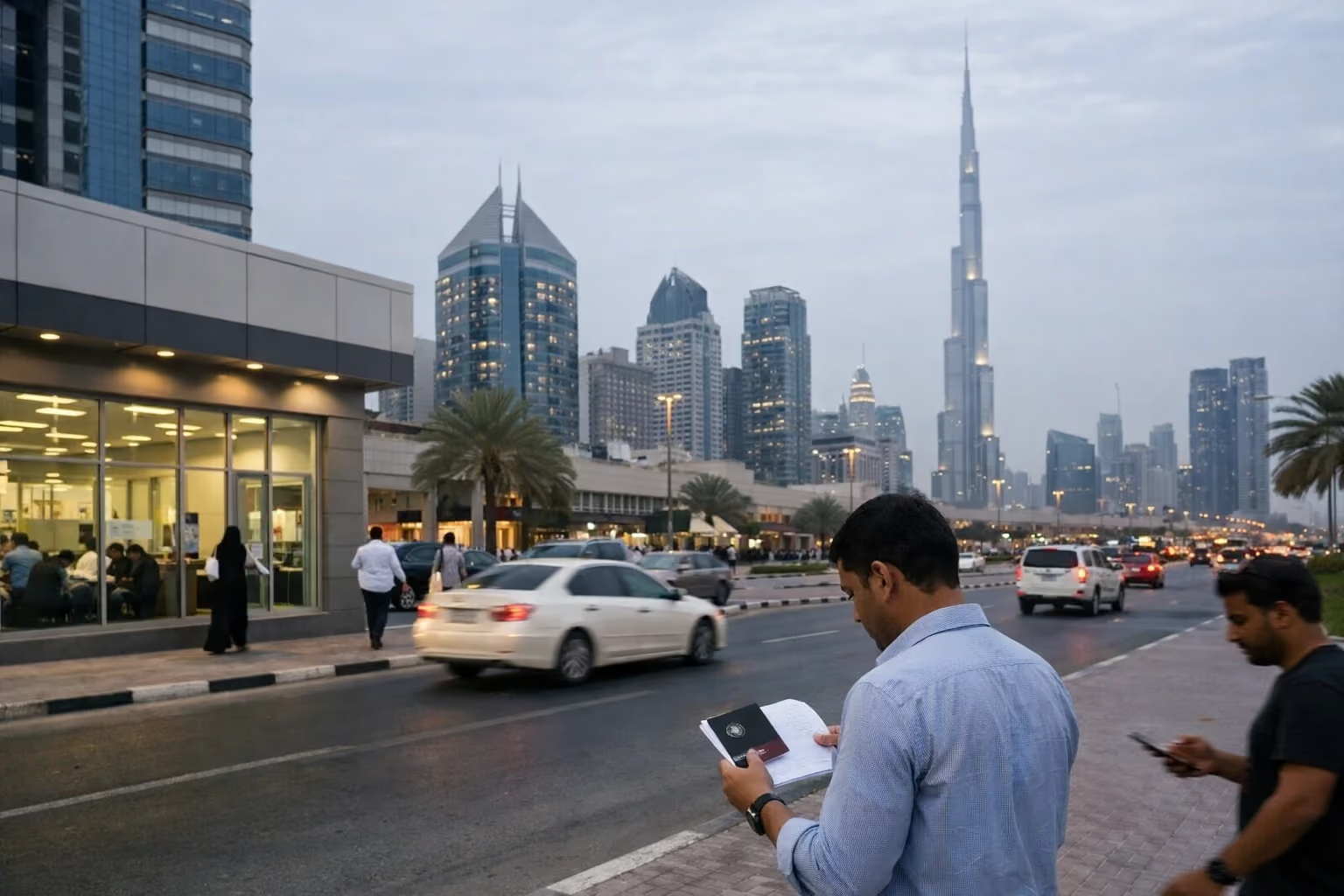

If your home country is on the RTA's exchange list, you can walk out with a Dubai driving licence in a day or two, for a few hundred dirhams, without sitting a single test. If it is not, you are looking at a full driving-school programme costing several thousand dirhams over two to six months. That one distinction is worth checking before you do anything else — and there is a second, more urgent point most new arrivals miss entirely: the moment your residence visa is issued, your foreign licence stops being valid here. This guide covers who can exchange, what it costs, how the process runs, and the traps that get applications rejected.
Recognition vs Exchange: The Distinction That Catches People Out
The UAE treats visitors and residents completely differently, and confusing the two is the single most expensive mistake in this area.
- Licence recognition applies to visitors. On a visit or tourist visa, if you hold a valid licence from an eligible country, you can simply drive on it for the duration of your stay. If your licence is not from an approved country, or is not issued in English or Arabic, you need an International Driving Permit alongside the original.
- Licence exchange applies to residents. Once you hold a UAE residence visa and Emirates ID, you can no longer drive on your foreign licence at all. You must exchange it, or take the full test programme if you are not eligible.
An International Driving Permit does not bridge this gap. IDPs are valid only on visit visas — residence visa holders and Golden Visa holders cannot drive on one. Visitors using an IDP are also restricted to rental vehicles or vehicles registered to a first-degree relative, meaning a parent, sibling or spouse.
The consequences of getting this wrong are not administrative. Driving as a resident on a foreign licence is a traffic violation under UAE federal traffic law, and — the part that actually hurts — insurers may reject a claim where the driver held residency but no valid UAE licence. A minor collision becomes an uninsured one.
Who Can Exchange: The Official Position
The RTA maintains the authoritative list. As of its January 2026 statement, the service covers 57 licence origins, broken down as five GCC states, 38 European countries, 13 Asian and Latin American countries, and one African country. During 2025 the RTA processed 58,082 foreign licence exchanges in Dubai alone, against 558,191 new driving licences issued across the UAE that year.
Recent additions named by the RTA include Kyrgyzstan, Kosovo, North Macedonia, the State of Texas and Croatia. In June 2026 the UAE signed a memorandum of understanding with Kazakhstan on mutual recognition and exchange; at the time of that announcement the official RTA list had not yet been updated to include it.
Eligibility rests on the licence's country of issue, and there are two further conditions: the licence must be valid at the time of application, and the applicant must attend in person.
GCC states
Saudi Arabia, Kuwait, Bahrain, Oman and Qatar. GCC licence holders have the most straightforward route, given regional traffic law alignment. If you hold a GCC passport and a licence issued by that same country — or by one of the approved exception countries — you can exchange in Dubai regardless of which emirate issued your Emirates ID.
European countries
The largest group at 38. The countries named on the RTA list include Albania, Austria, Belarus, Belgium, Britain, Bulgaria, Croatia, Cyprus, Denmark, Estonia, Finland, France, Germany, Greece, Hungary, Iceland, Ireland, Italy, Kosovo, Latvia, Lithuania, Luxembourg, Malta, Montenegro, the Netherlands, North Macedonia, Norway, Poland, Portugal, Romania, Serbia, Slovakia, Slovenia, Spain, Sweden and Switzerland.
Turkey is on the list with an additional condition: a Driving Licence Data Certificate issued by the relevant consulate or embassy is required alongside the standard documents.
The RTA states 38 European origins; the names above account for most but not all of them, which is precisely why the portal rather than any published list is the thing to check for your specific country.
North America, Australasia and Asia
The remainder of the list covers the countries most commonly cited by applicants: the United States, Canada, Australia, New Zealand, Japan, South Korea, Singapore, Hong Kong and Kyrgyzstan, among others.
The United States entry has a quirk worth knowing. The RTA service page lists “Texas (United States of America)” and “United States of America (with the exception of the State of Texas)” as two separate entries, which is part of why the total count sits at 57 rather than the lower numbers still circulating.
Why You See 40, 49, 52 and 57 in Different Guides
Search for this topic and you will find four different totals, all presented confidently. The explanation is straightforward:
- The list genuinely grows. Kyrgyzstan, Kosovo, North Macedonia, Croatia and Texas were all added across 2025 and 2026, with Kazakhstan pending. Older articles were correct when written.
- Some entries are sub-national. Texas is counted separately from the rest of the United States, which inflates the count relative to a country-by-country tally.
- Some guides count only nationalities they recognise, or list “more than 40” as shorthand rather than reproducing the full schedule.
Treat the RTA portal as the only authority. The list changes by ministerial decision and bilateral memorandum, sometimes within weeks, and any list published anywhere — including this one — is a snapshot. Check your specific country on the RTA service page before you book anything or make plans around it.
What the Exchange Costs
The financial gap between eligible and ineligible is the whole reason this matters.
| Item | Fee (AED) | Note |
|---|---|---|
| Traffic file opening | ~200 | One-time |
| Licence issuance fee | ~600 | Main charge |
| Knowledge and innovation fees | ~50 | Includes AED 20 innovation fee |
| Eye test | 150 – 200 | At an approved vision centre |
| Certified translation | Varies | If the licence is not in English or Arabic |
| Typical exchange total | 400 – 1,000 | One to three working days |
| Full course, if not eligible | 3,000 – 9,000 | Two to six months |
If your licence is issued in a language other than English or Arabic, it will need certified legal translation by a Ministry of Justice-approved translator before the RTA will accept it. Some countries also require the licence to be attested, which is quicker and cheaper handled through document attestation than resolved at the counter on the day.
The Exchange Process, Step by Step
- Confirm eligibility on the RTA service page — specifically your country of issue, not your nationality.
- Complete an eye test at an approved vision testing centre. Results feed into the application electronically.
- Submit the application, either through the RTA website or at a Customer Happiness Centre across Dubai.
- Present the original foreign licence. It must be valid, and in most cases it is surrendered as part of the exchange.
- Attend in person. This is a stated requirement — the exchange cannot be completed entirely by proxy.
- Pay the prescribed fees, which vary by licence class.
- Collect the licence, typically issued the same day or within a few working days.
You must be a legal UAE resident to apply, which means a valid residence visa and Emirates ID with a sponsor — an employer, spouse or family member. If your Emirates ID is still processing, the exchange cannot proceed, so it sits behind the visa in the sequence. Our guides to the employment visa process in Dubai and how to check Emirates ID status cover where that sits, and dependants sponsored on a spouse visa follow the same rule — their own residency must be issued before they can exchange.
Why Applications Get Rejected
Most rejections come down to a mismatch rather than ineligibility.
- Passport and licence from different countries. Holding, say, a Finnish licence and a Dutch passport is frequently refused or made subject to additional eye and knowledge tests. Eligibility is assessed on the country of issue, but a nationality mismatch invites scrutiny.
- An expired licence. The foreign licence must be valid on the day you apply. Renewing it from abroad after arrival is far harder than doing so before you fly.
- Missing country-specific documents. Turkey's Driving Licence Data Certificate is the best-known example, but several countries carry their own additional requirement.
- Untranslated licences. Anything not in English or Arabic needs certified translation, not a photocopy with a note.
- Applying before residency is complete. No Emirates ID, no exchange.
Category matters too. An exchange generally covers the equivalent light vehicle category. Motorcycle, heavy vehicle and bus categories are treated separately and are not automatically carried across, even where the car licence exchanges cleanly.
If Your Country Is Not on the List
You take the full RTA programme: theory classes, a knowledge test, practical training hours at a licensed driving institute, an internal assessment and a final road test. Budget AED 3,000 to AED 9,000 and two to six months, with the wide range driven by how many road tests you need.
Two practical points. First, previous driving experience abroad can reduce the mandatory training hours at some institutes, so declare it and bring documentation. Second, the failure rate on the first road test is high enough that budgeting for one retake is realistic rather than pessimistic.
This is also worth weighing when you choose where to live. Communities without Metro access are effectively two-car communities, and if neither adult can drive for the first six months that is a genuine constraint on daily life. Our guide to the best neighbourhoods to live in Dubai maps communities against Metro access, and the cost of living in Dubai breakdown prices car ownership against a Nol pass — the gap is larger than most people expect once Salik, insurance and parking are counted.
A Realistic Timeline for a New Arrival
The licence sits at the end of a chain, and every step above it has to complete first. Working forward from landing:
| Stage | Typical timing | Can you drive? |
|---|---|---|
| Entry permit, before residency | On arrival | Yes, on a home licence or IDP, rentals only |
| Medical test and biometrics | Week 1 to 2 | Same as above |
| Residence visa stamped | Week 2 to 4 | No — home licence is now invalid |
| Emirates ID issued | Week 3 to 6 | No |
| Eye test and exchange application | After Emirates ID | No |
| Dubai licence issued | 1 to 3 working days | Yes |
Note the gap in the middle. There is a stretch — often two to four weeks, sometimes longer — between your residence visa being stamped and your Dubai licence being issued, during which you cannot legally drive at all. Your home licence has already lapsed in status and the replacement does not exist yet.
Plan around it rather than gambling on it. Practical options are the Metro and a Nol pass, taxis and ride-hailing, or a company driver if your employer provides one. This is also a strong argument for handling the eye test and gathering your documents in advance, so the exchange application goes in the same week your Emirates ID lands rather than a fortnight later.
If you are buying a car, hold off on completing the purchase until the licence is issued — registration and insurance both key off a valid UAE licence, and a vehicle sitting in a car park you cannot legally drive is an avoidable expense.
Dubai, Abu Dhabi and the Other Emirates
A UAE driving licence issued by any emirate is valid nationwide, but the issuing authority differs. Dubai's is the RTA; Abu Dhabi and the northern emirates process through their own licensing departments under the Ministry of Interior. The eligible-country list is federal and consistent, but fees, appointment systems and processing times vary between emirates.
Where you apply is determined by the emirate that issued your residence visa, with the GCC passport exception noted earlier. If you relocate between emirates after issuance, the licence remains valid — it is the renewal and any category additions that follow your residency.
Note also that these rules attach to residency, not to employment. Anyone on a UAE remote work visa or a Golden Visa is a resident for licensing purposes and must exchange or test like anyone else — the longer visa does not extend the grace on your home licence.
Sort Your Licence Alongside Your Residency with Takween Advisory
Two things are worth doing before you fly: check your country of issue against the current RTA list, and make sure your existing licence will still be valid on the day you apply in Dubai. Everything else follows the residency — visa first, Emirates ID, then the exchange. If your country is not on the list, factor the driving-school timeline into where you choose to live rather than discovering it after signing a lease in a community with no Metro. For the wider rules of the road, Salik, fines and insurance, see our guide to driving in Dubai on a foreign licence. Takween Advisory handles the residency layer this all depends on — residence and dependant visa services, document attestation and legal translation, and business setup in Dubai for founders sponsoring their own visa. Book a free consultation to get the sequence right.