
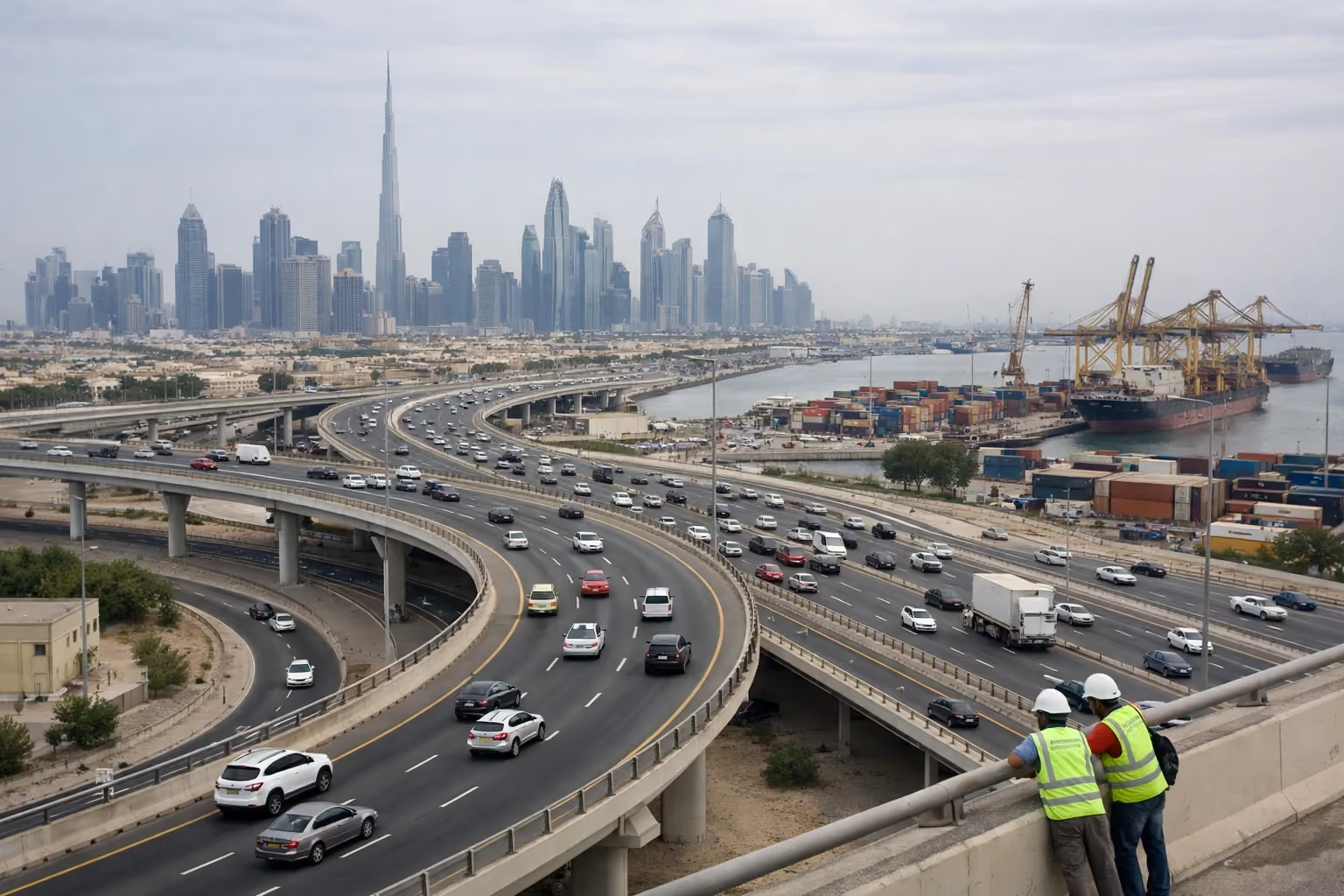

Most "best emirate" comparisons ask the wrong question - they line up Dubai against one other emirate purely on setup cost. Cost matters, but it isn't what should decide where a manufacturing business, a maritime trading company, or a fintech startup actually sets up. Each emirate has built real, specific infrastructure and ecosystem depth around particular industries, and matching your business to the right one matters more than shaving a few thousand dirhams off the licence fee. Here's how the seven emirates actually stack up by industry.
Quick Match: Industry to Emirate
| Industry | Best-Fit Emirate | Why |
|---|---|---|
| General trading, e-commerce, tourism, logistics (scale) | Dubai | The default global hub - deepest ecosystem, most established banking and logistics infrastructure |
| Financial services, funds, fintech, deep tech | Abu Dhabi (ADGM) or Dubai (DIFC) | Both run English common-law financial free zones with their own regulators - ADGM leans deep tech and sustainability, DIFC leans trade-finance scale |
| Manufacturing (broad, SME to mid-size) | Sharjah | Over a third of the UAE's factories operate here, across 33 industrial zones |
| Heavy industry, petrochemicals | Ras Al Khaimah or Sharjah's Hamriyah zone | Purpose-built industrial licensing and land at meaningfully lower cost than Dubai |
| Maritime, bunkering, oil storage and logistics | Fujairah | The world's third-largest bunkering hub, positioned outside the Strait of Hormuz |
| Media, content, influencer businesses | Dubai or Ajman | Dubai for scale and reach; Ajman Media City for lower-cost, fully remote setup |
| Low-cost SME trading, dropshipping, micro-business | Umm Al Quwain or Ajman | The lowest entry-level licence costs in the UAE, with fast issuance |
| Large enterprise, government-linked contracts, energy | Abu Dhabi | Home to the UAE's federal government and its energy sector anchor tenants |
Dubai: The Default for Trade, E-Commerce, Tourism, and Scale
Dubai remains the right default for any business that needs the deepest ecosystem, the most developed logistics and banking infrastructure, and maximum flexibility across free zone options. DIFC alone reached 10,018 active registered companies in H1 2026, up 30% year on year - a scale no other emirate's financial centre currently matches. For most trading, e-commerce, tourism, and general service businesses, Dubai's breadth is still the strongest starting point, even where another emirate might be marginally cheaper. We've broken down Dubai's cost position against Sharjah, Abu Dhabi, and RAK individually in our Dubai vs Sharjah, Dubai vs Abu Dhabi, and Dubai vs RAK comparisons.
Abu Dhabi: Financial Services, Deep Tech, and Government-Linked Industry
ADGM reached 13,353 active licences in Q1 2026, operating under its own English common-law framework and regulator - a strong pull for regulated financial firms, funds, and family offices specifically. Abu Dhabi's other clear differentiator is Hub71, a government-backed startup incentive program offering up to AED 750,000 per qualifying startup, which has no real equivalent elsewhere in the UAE. For industrial and heavy logistics operations, KEZAD offers land and energy costs that are genuinely competitive at scale. Abu Dhabi is also, straightforwardly, the seat of the UAE federal government and its energy sector's home base - which matters for businesses expecting meaningful government-linked contract work.
Sharjah: The UAE's Manufacturing Backbone
Sharjah contributes roughly 17% of the UAE's national GDP, with manufacturing as its second-largest economic contributor after retail and wholesale trade - and over 95% of that GDP comes from non-oil activity. It's home to more than a third of the UAE's total factories, spread across 33 industrial zones. Sharjah Airport International Free Zone (SAIF) hosts over 8,000 companies from 160 countries, while Hamriyah Free Zone - the UAE's second-largest industrial free zone - hosts over 6,500 businesses with a specific concentration in petrochemical, petroleum, and natural gas operations. For anything genuinely industrial - machinery, chemicals, rubber and plastics, electronics, or food and beverage production - Sharjah's manufacturing depth is unmatched by any other single emirate.
Ras Al Khaimah: Heavy Industry and Manufacturing at Lower Cost
RAKEZ is built specifically around manufacturing and heavy industry in a way most Dubai free zones aren't, with dedicated industrial licensing running roughly AED 12,000 to 30,000+ and genuinely lower warehouse and land costs than Dubai equivalents. For a manufacturing or heavy logistics operation that doesn't need daily in-person Dubai access, RAK is one of the clearest cost-to-capability trade-offs in the UAE.
Fujairah: Maritime, Bunkering, and Oil Logistics
Fujairah is the UAE's - and the world's - third-largest bunkering hub, handling roughly 7.5 million tonnes of bunker fuel sales in 2024, trailing only Singapore and Rotterdam globally. It operates over 12 million cubic metres of commercial oil storage capacity, with expansion planned toward 14 million cubic metres. Its strategic edge comes from sitting outside the Strait of Hormuz entirely - the 380km Habshan-Fujairah pipeline moves up to 1.8 million barrels of crude daily, bypassing the Strait completely, and this positioning gets even more valuable during periods of regional tension, when bunkering volumes at Fujairah have surged 10-20%. For any maritime, shipping, bunkering, or oil storage and logistics business, Fujairah isn't a secondary option - it's the specialised choice.
Ajman: Low-Cost Media and SME Operations
Ajman Media City Free Zone is purpose-built for digital and content businesses - social media and influencer activity, broadcasting, software development, and e-commerce - with licences allowing up to five business activities as long as one is media-related. It's also genuinely cheaper to run: health insurance isn't mandatory for visa processing here the way it is in most other zones, and the entire setup can be completed remotely with no physical UAE presence required. For a media, content, or influencer-driven business that doesn't need Dubai's reach specifically, Ajman is a materially lower-cost base.
Umm Al Quwain: The Lowest-Cost Entry Point
UAQ Free Zone consistently prices at the affordable end of the UAE market, with licences starting around AED 8,000 and a typical full setup - registration, licence, co-working space, establishment card, e-channel, and a two-year visa - landing around AED 32,400. Licence issuance runs 1 to 3 business days, among the fastest in the UAE, and UAQ supports a dual-licensing option that lets a trading business add a second activity category, like consultancy, to the same company. For a small trading operation, dropshipping business, or freelance-adjacent venture where minimising year-one cost matters more than a prestige address, UAQ is worth serious consideration.
Which One Actually Fits Your Business
The honest framework: pick Dubai by default unless a specific industry pulls you elsewhere with a real, quantifiable advantage - Sharjah for manufacturing depth, Fujairah for maritime and bunkering, Abu Dhabi for regulated finance or a Hub71 incentive fit, and RAK, Ajman, or UAQ when minimising setup cost genuinely outweighs the value of being in Dubai specifically. We've laid out the full cost breakdown across every structure type - free zone, mainland, and offshore, across all seven emirates - in our UAE business setup cost calculator.
Why Choose Your Emirate Through Takween Advisory
Picking the wrong emirate for your industry is an expensive mistake to unwind later - relocating a licence, re-registering with banks, and re-establishing local relationships all cost real time and money. Takween Advisory advises across every emirate and free zone in the UAE, matching structure to industry from the start. Book a free consultation to find the right fit for your business before you commit.
Best Emirate by Industry: Quick Reference Table
Here's a quick-reference summary of every figure covered in this guide.
| Item | Detail |
|---|---|
| DIFC active companies (H1 2026) | 10,018, up 30% year on year |
| ADGM active licences (Q1 2026) | 13,353 |
| Hub71 startup incentive (Abu Dhabi) | Up to AED 750,000 per qualifying startup |
| Sharjah's contribution to UAE GDP | ~17% |
| Sharjah's share of UAE factories | Over one-third, across 33 industrial zones |
| SAIF Zone companies | 8,000+ from 160 countries |
| Hamriyah Free Zone businesses | 6,500+ from 163 countries |
| RAKEZ industrial licence cost | ~AED 12,000 - 30,000+ |
| Fujairah's global bunkering rank | 3rd largest, ~7.5 million tonnes in 2024 |
| Fujairah oil storage capacity | 12 million m³, expanding toward 14 million m³ |
| UAQ Free Zone licence starting cost | ~AED 8,000 |
| UAQ typical full setup cost | ~AED 32,400 |